Have you ever wondered what trust does mean in contemporary world and how does cyber world full of gadjets influence our lives in rather negative way?
Lets take Facebook for first shot. If someone doesn't like me can chose which information I can see and which not on his/ her timeline. If he or she doesn't wanna talk in a given moment he or she is hiding from me on chat mode. If your husband is having an affair and she is one of his FB friends you won't even know because he has hidden friendlist from anyone to see.
Ah forgot to add that when we all changed into timeline it was possible to erase visibility of any activity from a choosen person. So if you are divorced or have a messy breakup in your history you can clean it all up like it never happened. But it is also a good tool for players- as they can erase entire history of their prior prey hunting.
All for the sake of privacy. All in a good cause.
Now let's take Skype. Skype on the surface does not lie. It can have a mode settled to busy, away, or available. Also logging off and...invisible but for evryone not a chosen one person.
Let's take yahoo - now here you can turn invisible to a given friend despite all other options.
Gmail chat wasn't so problematic at all, it had a red mode, orange mode, green mode and grey mode- but there again you could only hide from everyone not a chosen person. But to give you more comfort, geeks had already thought about another application to make your life easy - you can turn orange on demand. Orange mode on gmail chat used to be an indication of just being away- i.e. a real information. Now if someone is orange on gmail chat he or she can ignore any message incoming cause he or she is away on assumption, when literally being at his or her desk.
Let's take a look what does it do to our behavior? Do we have a courage to face someone? A civil courage to say simple "Hey, see I am busy now, please contact me later". Or "Look you behaved really awful and I don't want to be your friend anymore". Discuss and face people.
No, instead cyber world enables us to take comforting way outs, prolong things, wait endlessly for God knows what, enables deception very much.
How many people do you know who are not hiding on gmail?
How many people do you know who are not orange on gmail because they have installed some app?
How many people do you know who would honestly refuse to talk to you, say they have no time, or simply admit to be angry in a given moment?
Close to none?
Dudes, it is getting worse than that... there will be 0 in the 2.0 World.
***********
I dream about a home without cables, electricity, or any fancy electronics. But I love to write this blog, so I guess I am electicity dependant ass.
Wednesday, September 19, 2012

Sunday, September 16, 2012
Time of Honor
I am wondering why I have not written this post earlier. Maybe because admitting to love for a historic series is a faux-pais among sophisticated cosmopolitan circles of mine? Or because my own understanding is too intimate, at the edge of something very personal?
So now after 4 seasons and at the beginning of the 5th one I do admit my love to a series Time of Honor.
Some years ago during a project focused on renacting groups recreating historic events related to occupied Warsaw I heared from one lady- veteran about consulting a script for the series dedicated to parashooted underground soldiers - Cichociemni.
These guys were trained in Great Britain by their former Polish instructors to be parashooted on the occupied territories with aim to profesionally organize resistance against Nazis but also against the Soviets who basically occupied half of the country.
Time of Honor is a result of private passion of many people. it recreates realities of pre-war Warsaw, occupation, Soviet invasion but also later hopeless fight put against Soviet domination and fiction state Stalin imposed in Jalta.
The script follows a story of friendship between 4 guys, their family life, love life and parallel stories. There is also a triangle. A Judas - Karol whose sister was held by Gestapo is trying to sell off his wife's friends into German hands. The very same Judas compromised by long term cooperation with the Germans starts cooperating with the Soviets. His wife leaves him during the war and unites with her lifetime love - trained underground soldier parashooted from Britain. Cichociemni - underground soldiers who never had given up their weapons and never recognized Soviet Polish state become his enemies forever. He would spend his life clinched between rests of remorse and passion for revenge... There is also a doctor Otto- a German with a golden heart who comes from Breslau and who faces death sentence for helping his love and friend dr Maria - wife of a Polish general. Each character has a unique and real personality, attitude, looks, style of walk, dress etc.
In the script there is nothing too long. No situation, no dialogue, nothing boring or too psychological. Pure action and thrill in war realities.
It is also not patriarchal story of brave male cocky dominance. They are male and female, but all of them are in combat despite their obvious sexual differences. All of these women seem far less intellectually castrated than many I meet in my contemporary life.
Last but not least. Music makes it! The author of the music album made already international career and received many awards both in Poland and abroad. Chajdecki is not a noname in music world. He is just 32 - my age, but since 16 cooperates with such institutions like Yale School of Drama or New York School of Visual Arts.
The music for the series was nominated for IFMCA in 2011.
********
I cannot stop thinking that it somehow portrays private life and struggles of my grandma. It takes imagination to look at 86 year old woman and see Wanda or Ruda in her. Imagine she dressed and looked like the ladies in the series. That she behaved like them too... now she barely walks.
So now after 4 seasons and at the beginning of the 5th one I do admit my love to a series Time of Honor.
Some years ago during a project focused on renacting groups recreating historic events related to occupied Warsaw I heared from one lady- veteran about consulting a script for the series dedicated to parashooted underground soldiers - Cichociemni.
These guys were trained in Great Britain by their former Polish instructors to be parashooted on the occupied territories with aim to profesionally organize resistance against Nazis but also against the Soviets who basically occupied half of the country.
Time of Honor is a result of private passion of many people. it recreates realities of pre-war Warsaw, occupation, Soviet invasion but also later hopeless fight put against Soviet domination and fiction state Stalin imposed in Jalta.
The script follows a story of friendship between 4 guys, their family life, love life and parallel stories. There is also a triangle. A Judas - Karol whose sister was held by Gestapo is trying to sell off his wife's friends into German hands. The very same Judas compromised by long term cooperation with the Germans starts cooperating with the Soviets. His wife leaves him during the war and unites with her lifetime love - trained underground soldier parashooted from Britain. Cichociemni - underground soldiers who never had given up their weapons and never recognized Soviet Polish state become his enemies forever. He would spend his life clinched between rests of remorse and passion for revenge... There is also a doctor Otto- a German with a golden heart who comes from Breslau and who faces death sentence for helping his love and friend dr Maria - wife of a Polish general. Each character has a unique and real personality, attitude, looks, style of walk, dress etc.
In the script there is nothing too long. No situation, no dialogue, nothing boring or too psychological. Pure action and thrill in war realities.
It is also not patriarchal story of brave male cocky dominance. They are male and female, but all of them are in combat despite their obvious sexual differences. All of these women seem far less intellectually castrated than many I meet in my contemporary life.
Last but not least. Music makes it! The author of the music album made already international career and received many awards both in Poland and abroad. Chajdecki is not a noname in music world. He is just 32 - my age, but since 16 cooperates with such institutions like Yale School of Drama or New York School of Visual Arts.
The music for the series was nominated for IFMCA in 2011.
********
I cannot stop thinking that it somehow portrays private life and struggles of my grandma. It takes imagination to look at 86 year old woman and see Wanda or Ruda in her. Imagine she dressed and looked like the ladies in the series. That she behaved like them too... now she barely walks.
Saturday, September 15, 2012
Vajecny Sen
This is a story of childhood and dreams, also story of friendship and bonding...but let the tale begin.
When I was a little girl my dad used to take us all to Czechoslovakia ( now Czech and Slovakia) for long months of almost constant holidays. He never did care much wether we skip June and September of school cause he considered travelling much more schooling in our upbringing.
Indeed we have seen so many places, met so many people, I even got my first adorer that time- a nice fether of peacock from the Kinsky Castle was delivered straight into my hands by a very handsome dad's colleague :)
During that time I remember we had our tastes. We were testing local cusine and beverages. One of those snacks was Vyprazany Syr - baked cheese, legendary for those who know Czech Republic.
There was also beer which we could have tasted in little portions during that time, other times drinking non alcoholic beer sold in Czech Pubs especially for children. Yes, Czech Pubs are family places, not just spots full of drunken guys.
One of thoise childhood tastes is Vajecny Sen. This legendary liquor being produced in Dolny Kubin in Slovakia already has growing number of fans on Facebook. Also it is something which never lost quality during communism and something which does still taste good and was not bought by any French or German mass shit production corporate business.
This is how it looks:

This year I think I already had at least 5 bottles of Vajecny and some of them prepared for gifts. But because it is so fast gone I started researching if I can do it myself.
And guess what, yes I can. I will share here just a general receipe:
Składniki:
6 yellow parts of the egg
250 ml spirit or vodka
750 ml condensed milk
1 glass of sugar
1 pack of vanilla sugar
2 dark non sugared chocolates
Yolks mash with sugar to the clear mass, add milk, mix, later alcohol, mix, chocolates melt on the steam and add a bit of water. cool it down a bit, bottle it, close it. Leave for 24hrs. Shake. ready. Bon apetite!
Ah bonding issue: this is something you share with people. And if you think that you share it with a friend you know for 22 yerars...or 26 years... this is empasising bond. If you cannot make a beverage with your long term friend, you can't talk to people, can't connect with them...you are so very poor. Your life is empty, even if you had all of the money of this world. This is another person around making you rich.
When I was a little girl my dad used to take us all to Czechoslovakia ( now Czech and Slovakia) for long months of almost constant holidays. He never did care much wether we skip June and September of school cause he considered travelling much more schooling in our upbringing.
Indeed we have seen so many places, met so many people, I even got my first adorer that time- a nice fether of peacock from the Kinsky Castle was delivered straight into my hands by a very handsome dad's colleague :)
During that time I remember we had our tastes. We were testing local cusine and beverages. One of those snacks was Vyprazany Syr - baked cheese, legendary for those who know Czech Republic.
There was also beer which we could have tasted in little portions during that time, other times drinking non alcoholic beer sold in Czech Pubs especially for children. Yes, Czech Pubs are family places, not just spots full of drunken guys.
One of thoise childhood tastes is Vajecny Sen. This legendary liquor being produced in Dolny Kubin in Slovakia already has growing number of fans on Facebook. Also it is something which never lost quality during communism and something which does still taste good and was not bought by any French or German mass shit production corporate business.
This is how it looks:

This year I think I already had at least 5 bottles of Vajecny and some of them prepared for gifts. But because it is so fast gone I started researching if I can do it myself.
And guess what, yes I can. I will share here just a general receipe:
Składniki:
6 yellow parts of the egg
250 ml spirit or vodka
750 ml condensed milk
1 glass of sugar
1 pack of vanilla sugar
2 dark non sugared chocolates
Yolks mash with sugar to the clear mass, add milk, mix, later alcohol, mix, chocolates melt on the steam and add a bit of water. cool it down a bit, bottle it, close it. Leave for 24hrs. Shake. ready. Bon apetite!
Ah bonding issue: this is something you share with people. And if you think that you share it with a friend you know for 22 yerars...or 26 years... this is empasising bond. If you cannot make a beverage with your long term friend, you can't talk to people, can't connect with them...you are so very poor. Your life is empty, even if you had all of the money of this world. This is another person around making you rich.
Thursday, August 16, 2012
Glympses of holidays
It's holiday time. Everyone travels, so do I. I had a chance to learn how huge is my own country and - how diverse it is.
 Above: New water sports center in Olsztyn
Firstly I went to Tatras and Cracow and enjoyed the south. Next I went to a friend to Olsztyn and stayed a couple of days with her.
This is Ermland, Warmia in Polish, one of historic provinces of Poland which always crushed with Teutonic Order, later taken by Prussian Kingdom to be finally considered a part of Heimat by Bismarck who unified Germany - which was inherited by the Nazi era and considered part of Germany by them too.
This all was named Ost Preussen by Bismarck. But it is a country of constant struggle between identities, economic ideas and ways of life for many centuries.

 Above: Olsztyn Streets
Historically Preussen - Prusy in Polish was inhabited by Prussian tribes which bothered Mazovian Polish Dukes. Duke Conrad in 1226 thought he has enough of constant raides from the North and invited teutonic Order to settle peace at the border with hopes that conquered lands will fall to his prey later on.
But this did not happen... greed and brutality took over. Teutonic Knights travelled dressed in white coats with black single big cross with their eyes covered in steel helmets causing fear among locals... with time financial triubutes were raised so much that local people strived for survival. And Teutonic Order did not have enough. It went south and east...south and east....raised taxes and exploited lands...until in 1380's Polish rulers had enough and thought it is time to settle the matters final.
King Jagiełło - The Jagiellon - married the King of Poland ( yes no mistake) Jadwiga and unified the state into first form of European Union of that era - Polish Lithuanian State. His joint forces made a huge battle with Teutons in 1410. Battle which you still have a chance to watch as it is being recreated every year for quite a while now.
On one warm July day he smashed Teuton Knights and had a chance to take over the whole Teuton State, but he only received a pledge from some dukes, did not decide to completely control Teutons which was a huge mistake...as they again started to exploit their region.
Bishops of Ermland unlike surrounding provinces pledged loyalty to Polish state and decided to bound their fate with the Polish Kingdom. Ermland became a refuge for persecuted peasants and city merchants who could not expand trade elsewhere. During that time Copernicus worked as a governor of the province for some years, and it is there where he observed the sky so accurate that he written down his ideas thanks to which Columbus travelled westwards to India...


Above: Lidzbark Castle
Later Teutons decided to put an end to a Teuton State, secularized themselves and became more and more protestant with time. When previous Teuton Lands were protestant Ermland remained catholic. Masuren and Ermland resemble long era of complicated history and unique local mentality...
Russian Soviet army had put an end to what it used to be in 1945. For several more years their Death Squadrons wandered around vast forests and lakes and made sure that no more local inhabitants really survived, no more who they pledged loyalty to. Those who had anything in common with Nazis fled westwards and to the sea, and those who stayed had done no harm to anyone...they stayed cause they either felt Polish ( yeah I know, weird... how do you feel it? But you do if you speak a slang for several centuries and you have glympses only of any identity) or they have done no harm to anyone.

Above: One of first printed versions of Copernicus research about the Earth, planets and the sun - to be admired at Lidzbark Castle
The Soviets installed their military bases and huge state owned agriculture industries. They have cancelled any private properties... maybe red brick Prussian style buildings were not beautiful but they were far more nice than a lot of commie era buildings which haunt till present days suddenly appearing in the middle of forest.
Ermland now is the land of mixed trails...on one hand young people emigrate seeing no hope. On the other hand old Germans buy properties to settle down during their retirement. Michelin produces tires, there is a good university too. But more investment is needed especially in towns and cities, because tourism is not enough- brings cash only to chosen lucky ones who bought lakeside properties... the vision is needed, new ideas and new hope.
Till then, enjoy the tale of Ermland in photos...
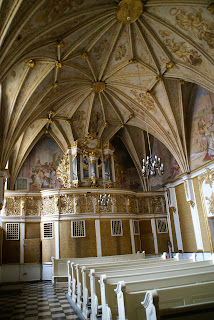


Above: Lidzbark Castle...years ago very rich, later plaundered by Swedish and others to be finally carefully taken care of by the passionate caretakers from the Museum of Mazury and Warmia
A must visit cities and objects in Ermland: Lidzbark Warmiński- castle and walk around the town, Dobre Miasto - medieval era churches, Olsztyn with cute old town and cathedral and Klubokawiarnia Filmowa (movie cafe), Frombork with cathedral and old town and many others... Most of the things to see either for free or for not more than 2- 3 € per ticket. Local transportation very decent, but it's better to take your own car because this area is full of treasures everywhere.
I am grateful for caretakers of the Museum of Warmia and Mazury at the castle of Lidzbark for answering our questions and giving us an insight to the past and present of the castle.

Firstly I went to Tatras and Cracow and enjoyed the south. Next I went to a friend to Olsztyn and stayed a couple of days with her.
This is Ermland, Warmia in Polish, one of historic provinces of Poland which always crushed with Teutonic Order, later taken by Prussian Kingdom to be finally considered a part of Heimat by Bismarck who unified Germany - which was inherited by the Nazi era and considered part of Germany by them too.
This all was named Ost Preussen by Bismarck. But it is a country of constant struggle between identities, economic ideas and ways of life for many centuries.


Historically Preussen - Prusy in Polish was inhabited by Prussian tribes which bothered Mazovian Polish Dukes. Duke Conrad in 1226 thought he has enough of constant raides from the North and invited teutonic Order to settle peace at the border with hopes that conquered lands will fall to his prey later on.
But this did not happen... greed and brutality took over. Teutonic Knights travelled dressed in white coats with black single big cross with their eyes covered in steel helmets causing fear among locals... with time financial triubutes were raised so much that local people strived for survival. And Teutonic Order did not have enough. It went south and east...south and east....raised taxes and exploited lands...until in 1380's Polish rulers had enough and thought it is time to settle the matters final.
King Jagiełło - The Jagiellon - married the King of Poland ( yes no mistake) Jadwiga and unified the state into first form of European Union of that era - Polish Lithuanian State. His joint forces made a huge battle with Teutons in 1410. Battle which you still have a chance to watch as it is being recreated every year for quite a while now.
On one warm July day he smashed Teuton Knights and had a chance to take over the whole Teuton State, but he only received a pledge from some dukes, did not decide to completely control Teutons which was a huge mistake...as they again started to exploit their region.
Bishops of Ermland unlike surrounding provinces pledged loyalty to Polish state and decided to bound their fate with the Polish Kingdom. Ermland became a refuge for persecuted peasants and city merchants who could not expand trade elsewhere. During that time Copernicus worked as a governor of the province for some years, and it is there where he observed the sky so accurate that he written down his ideas thanks to which Columbus travelled westwards to India...


Above: Lidzbark Castle
Later Teutons decided to put an end to a Teuton State, secularized themselves and became more and more protestant with time. When previous Teuton Lands were protestant Ermland remained catholic. Masuren and Ermland resemble long era of complicated history and unique local mentality...
Russian Soviet army had put an end to what it used to be in 1945. For several more years their Death Squadrons wandered around vast forests and lakes and made sure that no more local inhabitants really survived, no more who they pledged loyalty to. Those who had anything in common with Nazis fled westwards and to the sea, and those who stayed had done no harm to anyone...they stayed cause they either felt Polish ( yeah I know, weird... how do you feel it? But you do if you speak a slang for several centuries and you have glympses only of any identity) or they have done no harm to anyone.

Above: One of first printed versions of Copernicus research about the Earth, planets and the sun - to be admired at Lidzbark Castle
The Soviets installed their military bases and huge state owned agriculture industries. They have cancelled any private properties... maybe red brick Prussian style buildings were not beautiful but they were far more nice than a lot of commie era buildings which haunt till present days suddenly appearing in the middle of forest.
Ermland now is the land of mixed trails...on one hand young people emigrate seeing no hope. On the other hand old Germans buy properties to settle down during their retirement. Michelin produces tires, there is a good university too. But more investment is needed especially in towns and cities, because tourism is not enough- brings cash only to chosen lucky ones who bought lakeside properties... the vision is needed, new ideas and new hope.
Till then, enjoy the tale of Ermland in photos...


Above: Lidzbark Castle...years ago very rich, later plaundered by Swedish and others to be finally carefully taken care of by the passionate caretakers from the Museum of Mazury and Warmia
A must visit cities and objects in Ermland: Lidzbark Warmiński- castle and walk around the town, Dobre Miasto - medieval era churches, Olsztyn with cute old town and cathedral and Klubokawiarnia Filmowa (movie cafe), Frombork with cathedral and old town and many others... Most of the things to see either for free or for not more than 2- 3 € per ticket. Local transportation very decent, but it's better to take your own car because this area is full of treasures everywhere.
I am grateful for caretakers of the Museum of Warmia and Mazury at the castle of Lidzbark for answering our questions and giving us an insight to the past and present of the castle.
Friday, March 2, 2012
Wine goulash friday :)
Sometimes I do a wine goulash with variety of content. Whatever vegetables are there they end up in the pan and make goulash for me.
This time it was: 2 big carrots sliced into small tiny pieces, zukinie sliced into 0,5 cm pieces - 3 of them, 4 onions and 3 pieces of garlic. Spices included milled pepper, salt, sweet paprika powder and chilli paprika powder.
You can have it either with indian bread baked in tandoori oven ( matches very nice) or like me with small italian (real italian) macaroni balls.

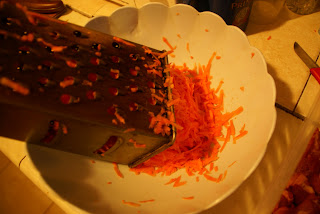

 Now the fun part.. After the onions cool down it comes time for paprika. You add up paprika as much as all the pieces are nicely covered with it- or even more. Paprika powder can not be burnt!!! Add spoon of chilli paprika powder too. Ideally it should be dark red, but somehow in Poland it ends up orange. Put it aside into a bigger pot where you will be doing the actual goulash. Start frying chopped meat ( either beef or pork or even poultry if you like).

Use bouplion dice or cook chicken leg long enough before you prepare everything. Ideally 1- 2 soup base dice are enough for 800 ml of water ( circa). Boulion should not be too salty! Once it's boiled add the prefried meet to your onions in the other pot and add up boulion as high as it almost covers meat.

 Some minutes after carrots when they are semi soft it's time for your zukinie. It is done quickly so watch it that it is just done but is not tearing into pieces. Check the taste, add some spices if you feel like it.
 Final touch is wine. If it happens that after some students party of a friend cheap red wine is a leftover, keep the bottle. Such wine is perfect for cooking. I usually add up half of the tea glass inside a pot with goulash and minute after turn off the heat. If your macaroni, potatoes, rice or indian bread is already there, start eating :) Enjoy :)

This time it was: 2 big carrots sliced into small tiny pieces, zukinie sliced into 0,5 cm pieces - 3 of them, 4 onions and 3 pieces of garlic. Spices included milled pepper, salt, sweet paprika powder and chilli paprika powder.
You can have it either with indian bread baked in tandoori oven ( matches very nice) or like me with small italian (real italian) macaroni balls.

First thing you do is glassing tiny chopped onions and garlic on olive oil or sunflower one ( will do as well). Later you put it aside and wait till it coold down.

Subsequently you have your carrots done like this above.

This is what you do with zukinie.


Use bouplion dice or cook chicken leg long enough before you prepare everything. Ideally 1- 2 soup base dice are enough for 800 ml of water ( circa). Boulion should not be too salty! Once it's boiled add the prefried meet to your onions in the other pot and add up boulion as high as it almost covers meat.

Once you see meat is soft add up carrots. Keep watching if you still feel strong paprika scent and taste ( don't mean too spicy here, strong is that you can differentiate you actually smell and taste paprika. If not, add some.
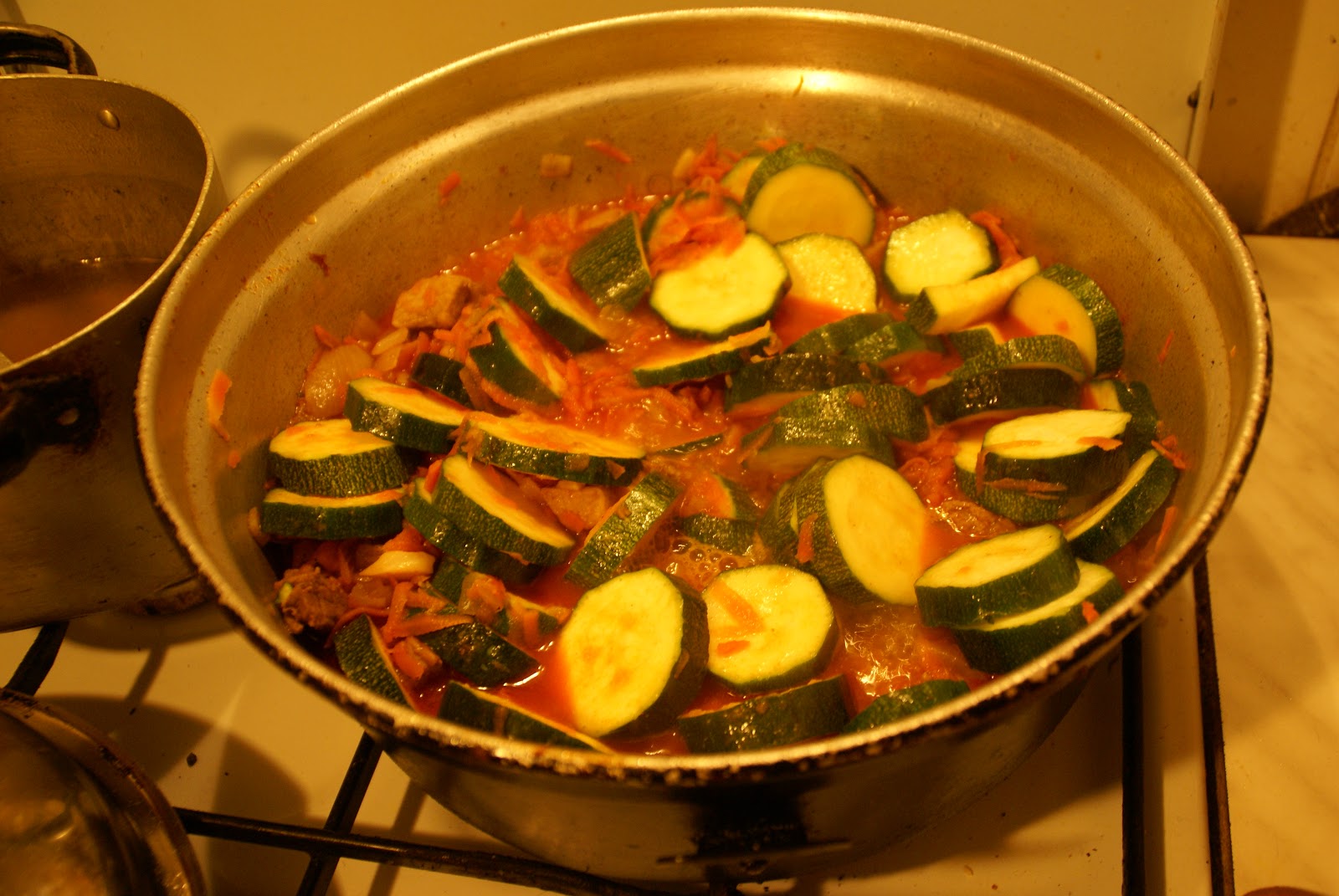


This is my ready dish. With it a half glass of the red wine from small family winery in Neustadt an der Weinstrasse and my day is done. I have not done a single important or productive things today. I have a headache since very morning and decided to take a rest and enjoy cooking. Bon apetite! Let me know how was it.
Wednesday, December 21, 2011
A wound of betrayal
One of the Warsaw modern cinemas. After 15 minutes the sound of pop-corn stopped annoying me. No, they did not finish it, they just stopped eating. For the first 15 minutes of the movie quiet conversations go on. Nothing seems to happen on the screen.
Indeed for people brought on with pompous and effective image of MI6 draw in their heads by James Bond, his fellow, George Smiley (excellent Gary Oldman) seems to be absolutely boring.

He is not sexy either. He wears grey coat and thick glasses, his hair could have seen a hairdresser weeks earlier. He seems to be grey guy doing grey job.
But the real picture of an intelligence officer is exactly that average looking chap. Watching his actions, we may feel like in a theatre. Despite moving around the streets on occasion, most of the plot happens between just a few people in not more than 4 or 5 rooms. Engaging dialogues in harmonious calm set where even a bee has it's place.
"Tinker, Tailor, Soldier, Spy" has one genuine strength. The very very realistic scenery. Every detail in the movie is worked perfectly. There are no GSM towers on the horizon, or too modern cars, or any cellphone ringing anywhere. It is real London of the 70's, a little bit brownish, grey, rainy with low buildings, always dirty from forever smog.
The extreme accuracy with which the movie is done is I suppose a result of a close cooperation between the director Thomas Alfredson and the author of the book upon which the movie was done, John le Carre.
While every single of John le Carre's books is an ideal real life plot full of surprising events among very boring normal people, the book "Tinker, Tailor, Soldier, Spy" is a special one. David John Moore Cornwell, as is le Carre's real name has got 20 years of active service in British intelligence. His role and identity in the Circus as MI6 is called among the workers, got burnt down due to betrayal of Kim Philby, one of the Great Five, group of smart Oxford students recruited into intelligence work. By writting the "Karla Trilogy" le Carre deals with memories of his own past in the service. Only long after those events he can finally write about it and be not afraid for his life.
In history there had been probably a number of moles situated at the top of British intelligence. One of them was allegedly Richard Hollis, the very head of MI5. Peter Wright who first wrote a book about him, could not have printed it anywhere outside Australia. He was forced into retirement and lived as a farmer until his death as a millionaire due to sells of his book "Spycatcher".
Several days ago the identity of another Russian spy who tried to infiltrate British high class was revealed by Daily Telegraph. Mikhail Repin, young, synpathetic, witty gentleman who spoke flawless english had done his best to try to recruit members of the Parliament and officials working at Downing Street 10.
He was cought. Maybe there is hope for Britain, that the country may improve it's image which got really compromised. If indeed there was a mole at the top, a lot of events in the history of 20th century makes sense, including the story of Polish army in the West which got buried officially and banned from publically being spoken about until the very fall of communism. There is indeed something in it....
For those boys who dream in their mucho heads about James Bond life. Beware.
Cash, maybe. Women, sometimes.
Peace of mind, never. Friends, never. Watching behind your shoulder, always.
***********
"Tinker, Tailor, Soldier, Spy", Thomas Aldredson, 2011.
Indeed for people brought on with pompous and effective image of MI6 draw in their heads by James Bond, his fellow, George Smiley (excellent Gary Oldman) seems to be absolutely boring.

He is not sexy either. He wears grey coat and thick glasses, his hair could have seen a hairdresser weeks earlier. He seems to be grey guy doing grey job.
But the real picture of an intelligence officer is exactly that average looking chap. Watching his actions, we may feel like in a theatre. Despite moving around the streets on occasion, most of the plot happens between just a few people in not more than 4 or 5 rooms. Engaging dialogues in harmonious calm set where even a bee has it's place.
"Tinker, Tailor, Soldier, Spy" has one genuine strength. The very very realistic scenery. Every detail in the movie is worked perfectly. There are no GSM towers on the horizon, or too modern cars, or any cellphone ringing anywhere. It is real London of the 70's, a little bit brownish, grey, rainy with low buildings, always dirty from forever smog.
The extreme accuracy with which the movie is done is I suppose a result of a close cooperation between the director Thomas Alfredson and the author of the book upon which the movie was done, John le Carre.
While every single of John le Carre's books is an ideal real life plot full of surprising events among very boring normal people, the book "Tinker, Tailor, Soldier, Spy" is a special one. David John Moore Cornwell, as is le Carre's real name has got 20 years of active service in British intelligence. His role and identity in the Circus as MI6 is called among the workers, got burnt down due to betrayal of Kim Philby, one of the Great Five, group of smart Oxford students recruited into intelligence work. By writting the "Karla Trilogy" le Carre deals with memories of his own past in the service. Only long after those events he can finally write about it and be not afraid for his life.
In history there had been probably a number of moles situated at the top of British intelligence. One of them was allegedly Richard Hollis, the very head of MI5. Peter Wright who first wrote a book about him, could not have printed it anywhere outside Australia. He was forced into retirement and lived as a farmer until his death as a millionaire due to sells of his book "Spycatcher".
Several days ago the identity of another Russian spy who tried to infiltrate British high class was revealed by Daily Telegraph. Mikhail Repin, young, synpathetic, witty gentleman who spoke flawless english had done his best to try to recruit members of the Parliament and officials working at Downing Street 10.
He was cought. Maybe there is hope for Britain, that the country may improve it's image which got really compromised. If indeed there was a mole at the top, a lot of events in the history of 20th century makes sense, including the story of Polish army in the West which got buried officially and banned from publically being spoken about until the very fall of communism. There is indeed something in it....
For those boys who dream in their mucho heads about James Bond life. Beware.
Cash, maybe. Women, sometimes.
Peace of mind, never. Friends, never. Watching behind your shoulder, always.
***********
"Tinker, Tailor, Soldier, Spy", Thomas Aldredson, 2011.
Tuesday, June 7, 2011
The Way Back
...in other words, I would expect more of Peter Weir.

But let's start from the very beginning. Some time ago I had finally seen that movie just because of family reasons. After all Siberian experience of forced labor, escapes from the camps, death shots in Katyń woodlands or elsewhere, that's all a family history, so watching a movie done by a great director in 21st century may make this thing kind of closer.
There are several guys in the camp of several different ethnicities. Some of them Russian, some of them French and a Polish guy (Jim Sturgees) who was betrayed by his own wife. Not of her own will, obviously. Soviet bastards forced her to do this. After all if you rape or beat the lady, not many of them are tough enough not to talk what the "authorities" want to hear.
In the camp we see rules of life. Urkas are the rule and among them the leader - called exactly Urka (Colin Farrell), not Walka like some idiots writting movie reviews want us to believe.
Soviets divided prisoners into political ones: enemies of the state, and Urkas - mere criminals, rapists, murderers, etc. After all every system has this kind of people. They had been rewarded by the camp rulers for spying on those political ones and exactly that is shown in the movie. Scenes in the camp belong to the best ones, because the rest is unfortunately not as good.
The rest of the movie shows the escape and obstacles on the way. But something was wrong with music. This movie had been too silent. Semi-desert had also been too silent. Several times there have been scenes repeated picturing the group walking down the bank of the Baikal Lake (deepest one in the world). These scenes might have been of bigger variety of angles, light etc.
Strong sides of the movie? Yes, there are two of them, well three. At first people responsible for light should be awarded with Oscar. It's been quite a while since I had seen a movie where light was worked out to the tiny detail. Currently noone seems to care and very often we see that a person is additionally lit up with a 300W light bulb even if the scene is shot outdoors. This is against a lot of rules, but rich producers of nowadays explain it by budget reasons. Oh really? They receive 10x that much as their predecessors some 20 years ago and yet 20 years ago light was light. It had to be obeyed with no exceptions.
So if you want to see a movie where a sunlight is a sunlight and if it shines it shines properly with right intensity from the proper side of a person, you should watch The Way Back to learn how to do it. If compared hardly any movie of recent matches up to this standard, and here including Avatar, Sherlock Holmes and many others.
Another plus is the scene when Urka decides to stay. In some conversations with Russian dissidents or from Vladimir Bukovsky book I have learned that the lowest category wolf still never ever leaves his pack. And that the most Soviet people did not want to pay the price of freedom. Known hell is still better than unknown heaven.
The third good thing in the movie is a feeling of reunion... a march to freedom, when finally in 1989 a husband can hug a wife whom he had not seen since 1940's. I won't say more. I would expect much much more of Peter Weir, but nevertheless it is a movie worth watching.

But let's start from the very beginning. Some time ago I had finally seen that movie just because of family reasons. After all Siberian experience of forced labor, escapes from the camps, death shots in Katyń woodlands or elsewhere, that's all a family history, so watching a movie done by a great director in 21st century may make this thing kind of closer.
There are several guys in the camp of several different ethnicities. Some of them Russian, some of them French and a Polish guy (Jim Sturgees) who was betrayed by his own wife. Not of her own will, obviously. Soviet bastards forced her to do this. After all if you rape or beat the lady, not many of them are tough enough not to talk what the "authorities" want to hear.
In the camp we see rules of life. Urkas are the rule and among them the leader - called exactly Urka (Colin Farrell), not Walka like some idiots writting movie reviews want us to believe.
Soviets divided prisoners into political ones: enemies of the state, and Urkas - mere criminals, rapists, murderers, etc. After all every system has this kind of people. They had been rewarded by the camp rulers for spying on those political ones and exactly that is shown in the movie. Scenes in the camp belong to the best ones, because the rest is unfortunately not as good.
The rest of the movie shows the escape and obstacles on the way. But something was wrong with music. This movie had been too silent. Semi-desert had also been too silent. Several times there have been scenes repeated picturing the group walking down the bank of the Baikal Lake (deepest one in the world). These scenes might have been of bigger variety of angles, light etc.
Strong sides of the movie? Yes, there are two of them, well three. At first people responsible for light should be awarded with Oscar. It's been quite a while since I had seen a movie where light was worked out to the tiny detail. Currently noone seems to care and very often we see that a person is additionally lit up with a 300W light bulb even if the scene is shot outdoors. This is against a lot of rules, but rich producers of nowadays explain it by budget reasons. Oh really? They receive 10x that much as their predecessors some 20 years ago and yet 20 years ago light was light. It had to be obeyed with no exceptions.
So if you want to see a movie where a sunlight is a sunlight and if it shines it shines properly with right intensity from the proper side of a person, you should watch The Way Back to learn how to do it. If compared hardly any movie of recent matches up to this standard, and here including Avatar, Sherlock Holmes and many others.
Another plus is the scene when Urka decides to stay. In some conversations with Russian dissidents or from Vladimir Bukovsky book I have learned that the lowest category wolf still never ever leaves his pack. And that the most Soviet people did not want to pay the price of freedom. Known hell is still better than unknown heaven.
The third good thing in the movie is a feeling of reunion... a march to freedom, when finally in 1989 a husband can hug a wife whom he had not seen since 1940's. I won't say more. I would expect much much more of Peter Weir, but nevertheless it is a movie worth watching.
Subscribe to:
Posts (Atom)